

Warning
This is a deliberately provocative article; I am not expecting you to agree, but it does, I hope, raise some valuable questions. I will respond to the discussion points, but not aimless rants or ad hominem attacks. We have the right to our opinions and, more relevantly, our considered opinions. Debates for improving our thinking often start with contrary statements and ideas.
I am also not sure I agree with myself!
An Eye, Politely Averted
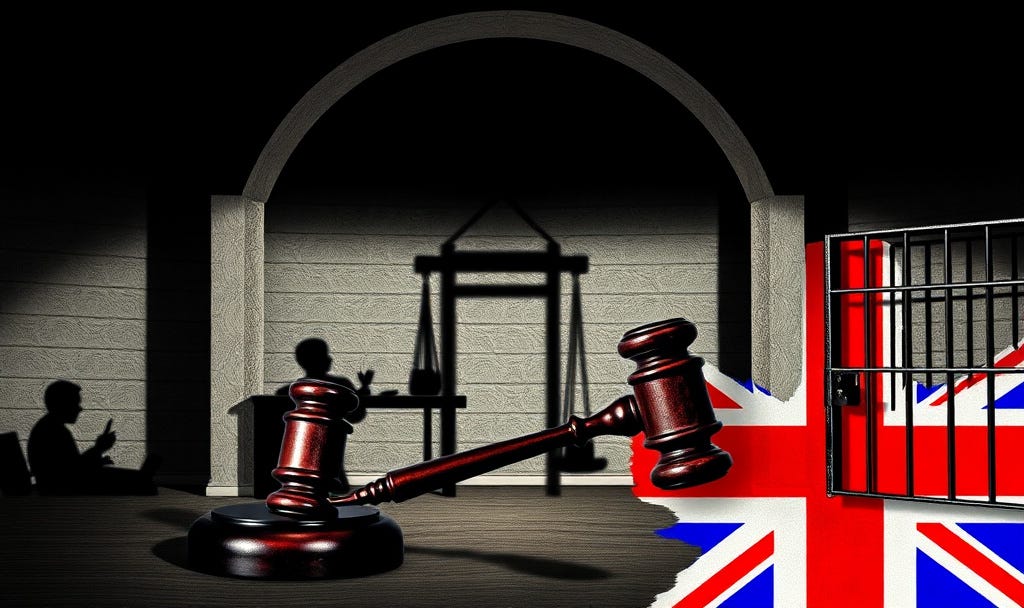
On British justice, the gallows we abolished but never quite surrendered, and the question we take care not to ask.
I. The Verdict from the Armchair
A man does something unspeakable. The trial ends. The sentence is read. And somewhere, in a pub or a kitchen or a comment thread, the real verdict arrives.
“He’ll not last long inside.”
We say it with satisfaction. We say it the way we might remark on the weather. There is a warmth to it. A child has been harmed, a life taken, and we have found our comfort. The wing will see to him. The other men will know what he did. Justice, the proper kind, the kind with teeth, will be done in a place we cannot see and need not think about.
We do not call this the death penalty. We abolished that. We are civilised now.
We simply hope.
II. The Thing We Put Down
Britain stopped hanging people in 1964.[1] Two men went to the gallows that August morning, one in Liverpool and one in Manchester, for a murder over money. Nobody marked the date. The next year, Parliament suspended capital punishment for murder, and four years after that, made the suspension permanent.[2] By the end of the century, it was gone from the statute book altogether, even for treason.
This was presented as progress. An ascent. We had climbed out of the pit and would not be going back.
There was only one difficulty. The public never truly agreed.
For decades after abolition, poll after poll showed a majority wanting the rope returned. The law had walked on ahead. The feeling stayed where it was. And a feeling that cannot speak does not die. It goes quiet. It waits. It finds another door.
III. The Spectacle We Lost
We were not always so delicate.
For most of our history punishment was theatre, and the theatre was free. The gallows at Tyburn stood where Marble Arch stands now, and the journey there, three miles from Newgate, was a public holiday in all but name. Crowds came. Vendors sold pies and pamphlets. The condemned were expected to perform, to repent or to swagger, and a good death drew applause.
This was justice you could watch. Justice with a date and a place and a smell.
The list of things that could put you on that cart was extravagant. By the early nineteenth century the law named more than two hundred capital offences.[3] You could hang for stealing goods worth a few shillings. You could hang for poaching, for forgery, for keeping the company of gypsies a month. The severity was the point. The severity, it was thought, would frighten the rest of us into virtue.
It did not.
Pickpockets are recorded working the crowds that gathered to watch pickpockets hang. The lesson was there for anyone willing to read it. People do not weigh consequences they never expect to face. The Italian jurist Beccaria had argued as much in 1764.[4] It is not the severity of a punishment that deters, he held, but its certainty. A small penalty that always falls does more than a terrible one that rarely does.
So if the spectacle did not deter, what was it for?
The sociologist Émile Durkheim gave the unsettling answer. Punishment, he argued, is not really aimed at the criminal at all. It is a ritual performed for everyone else. When we punish, we draw a line and stand on the right side of it together. The hanging was never a lesson for the thief. It was a service for the crowd. It told them who they were.
Read that again, slowly. Then think of the pub, and the wing, and the warmth in your own voice.
The public hanging ended in 1868.[5] The last man to die before a crowd was a Fenian, executed outside Newgate, and after him the scaffold went indoors. The French thinker Michel Foucault saw in this move something larger than decency. Punishment did not soften. It hid. The body was no longer broken in the square. The soul would be corrected in private, on a timetable, behind a wall. The crowd was sent home.
But the crowd did not lose its appetite. It only lost its lunch.
IV. Revenge in a Borrowed Coat
Here we must be careful with our words, because two of them are forever changing clothes.
Revenge is personal. It is hot. It has no limit and keeps no measure. You hurt mine, I hurt yours, then your cousin hurts mine, and the thing runs on forever.
Retribution is meant to be revenge with its collar buttoned. Cold, proportionate, handed to a third party who has no stake in it. “An eye for an eye” is misremembered as savage. It was the opposite. It was a ceiling. One eye, and not the man’s life. A brake, not an accelerator.
We built the whole apparatus of law to make that swap. Thomas Hobbes described the bargain plainly. We each hand our private right of vengeance to the state, and in return the state keeps the peace and settles our scores for us, without favour and without heat. We give up the knife. We get a court.
And then, quietly, we take the knife back.
When we hope a man will be made hell by his fellow inmates, when we trust the wing to deliver what the judge would not, we are reclaiming the very thing we promised to surrender. We want the outcome of the gallows without the vote for it. We want the death, and we want our hands clean.
There is a name for that posture, and a basin to go with it.
Pontius Pilate did not condemn the man before him. He washed. He let the crowd do the sentencing and kept his own hands dry, and for two thousand years we have despised him for it. Then we go home and hope the other prisoners will do our washing for us.
This is the distancing. This is the real subject. By putting the violence out to others we never have to admit that we want it. We keep the flattering self portrait, the humane nation that put the rope away, and we enjoy, at one remove, the satisfactions of a brutal one. The mob at Tyburn was many things, but it was honest. It came to see a death and it said so. We have not become more merciful than that crowd. We have become more squeamish, and more dishonest, which is not the same thing.
V. The Machine That Forgot
Kafka wrote a story about a machine.
In the penal colony an officer tends a beautiful and terrible device that executes prisoners by writing their sentence into their flesh with needles, slowly, over twelve hours, until they die. The officer loves the machine. He loves the old days, when crowds gathered to watch it work and understood its meaning. But the old commandant is dead, the new one is indifferent, the crowds have stopped coming, and nobody can quite remember what the machine is for any more. It still runs. It still kills. It has simply lost its reason. At the end the officer cannot defend the thing in words, so he lies down in it himself, and the machine, breaking, kills him without writing anything at all.
We have built our own machine, and it too has forgotten what it is for.
Ask it. Ask the British justice system what it is doing, and listen to the five answers it gives at once. It is here to deter. It is here to reform. It is here to protect us by keeping dangerous people away. It is here to give wrongdoers what they deserve. And, beneath all of it, never printed on any form, it is here to make someone suffer for our sake.
These aims do not point the same way. They pull against each other like dogs on one lead. Deterrence wants certainty and speed. Reform wants patience and money and the unfashionable belief that a person can change. Desert wants the punishment to fit, no more and no less. Protection only wants the door locked. And revenge wants pain, and is never quite satisfied, because pain does not bring the dead back.
A system asked to do all five at once, by a public that will not say which it wants most, cannot succeed. It can only disappoint everyone in turn. The reformer calls it cruel. The victim calls it soft. Both are right, because it is trying to be both, and a thing that faces every direction faces none.
Look at the machine now. The prisons of England and Wales sit at around ninety seven per cent of usable capacity, fuller than at any point in living memory.[6] To make room, men have been let out early, and the committee that looked into it found, at one prison, inmates with a single day of their sentence left being bussed to another prison overnight, simply to free a bed.[7] A bureaucracy moving a man twenty miles to sleep, on the last night of his punishment, so the books will balance. Kafka could not have bettered it.
And does any of this work, by the one measure that ought to matter, the prevention of the next victim? Around twenty eight in every hundred released offenders are convicted of a fresh crime within the year, and among those given short sentences the figure is far worse.[8] Most crime in this country is committed by people the system has already held in its hands and let go, unchanged.[9]
The machine runs. It still kills time, still costs fortunes, still fills and empties its cells. It has simply lost its reason.
VI. What It Is For
So we return to the question, which was never really about courts or sentences or cells.
Is the system broken? Perhaps not. Perhaps it is doing, with grim precision, exactly what an undecided people built it to do. Everything. And therefore nothing.
The fault, if we must find one, is not in the dock. It is in the armchair. We have never told the system what we want, because we have never been willing to say it aloud, even to ourselves. We want mercy in the law and vengeance on the wing. We want to abolish the gallows and keep the hanging. We want the man to suffer, and we want someone else to make him suffer, so that we may go on believing we are the gentle sort who never would.
The Grey Path teaches that the honest place is between the two lights, the candle and the star, refusing the comfort of a false choice. But there is a counterfeit grey, the grey of the man who will not decide because deciding would cost him something. That is where we have been hiding. Not in honesty. In evasion.
So here is a test, and you may try it tonight.
The next time you hear yourself say you hope he rots, that he will get what is coming, that he will not last a week inside, stop. Ask one question and answer it truthfully. Would you pull the lever yourself?
If you would, then say so plainly. Argue for the gallows in the open, where we can all see your face and weigh your reasons. There is more honour in that than in a whisper.
And if you would not, if your hand would shake on the lever and your stomach would turn, then ask why you are so content to let another man’s hand do the thing yours refuses. That gap, between what we permit and what we would do, between the death we want and the death we will not own, is not a flaw in the system.
It is the system.
We built it in our own image. We averted our eyes and called it justice.
Alan /|\
References
[1]Peter Anthony Allen and Gwynne Owen Evans, hanged on 13 August 1964, the last executions carried out in Britain.
[2]Murder (Abolition of Death Penalty) Act 1965, made permanent in 1969. The death penalty was removed from the statute book altogether, treason included, by 1998.
[3]The so called Bloody Code. By the early nineteenth century the law named more than two hundred capital offences.
[4]Cesare Beccaria, On Crimes and Punishments, 1764.
[5]Michael Barrett, hanged outside Newgate on 26 May 1868, was the last person publicly executed in Britain. The Capital Punishment Amendment Act of that year moved the gallows inside the prison walls.
[6]As of November 2025 the prison population of England and Wales stood at 86,888 against a usable operational capacity of 89,291, roughly 97 per cent. The population reached a record high in mid 2025. House of Commons Justice Committee, 2025.
[7]House of Commons Justice Committee, Ending the cycle of reoffending, 2025, reporting on HMP Elmley.
[8]The overall proven reoffending rate for England and Wales was 28.3 per cent for the cohort released between October and December 2023. Ministry of Justice.
[9]The Justice Committee noted that around 80 per cent of all offending is reoffending.