
Dr De Bono's Thinking on Thinking
Thinking Tools that work!

The Trouble With Being Clever
Edward de Bono spent his life annoyed by clever people. Not personally. Philosophically. He thought we had built a civilisation that worshipped one kind of mind, the analytical critic, and then acted surprised when the world stopped producing new ideas.
His complaint went like this. Schools teach logic. Universities teach more logic. Boardrooms reward people who can shoot down a proposal in under thirty seconds. We are excellent at judging ideas. We are hopeless at making them.
He once said that most thinking mistakes are not logical ones. They are mistakes of perception. The reasoning machine works fine. It is just being fed rubbish, and feeding it harder does not help.
Two stages, and we keep skipping one
De Bono split thinking into two stages. First comes perception. This is the part where the mind decides what it is looking at. What matters. What to ignore. What the problem even is.
Then comes processing. This is the logical part. The sums. The arguments. The Excel sheet.
Western education, he argued, obsessed over the second stage. Mathematics. Debate. Critical analysis. All processing. Meanwhile, the first stage, the part that quietly decides everything before the thinking even begins, was left to chance.
The result is familiar. A meeting where everyone reasons brilliantly toward the wrong conclusion. A strategy team that solves the problem nobody had. A bright graduate who can dismantle any argument but cannot make one of their own.
Logic, de Bono said, will not get you out of a hole that perception dug.
The mind as a self-organising mess
He had a theory for why this happens. The brain is a pattern-making system. It receives chaos and tidies it into familiar shapes. This is wonderful for survival. It is dreadful for novelty.
Once a pattern forms, the brain tends to prefer it. Information flows down the same grooves. We see what we have seen before. We solve problems the way we solved them last time. Yesterday becomes a tyrant.
This is why, de Bono said, you cannot think your way out of a fixed perception. You have to jump out of it. Sideways. Hence, the term he coined and never quite escaped. Lateral thinking.
Lateral thinking is not the same as creativity, which he found a vague and slightly embarrassing word. It is the deliberate breaking of patterns. You leave the well-worn path. You provoke yourself. You use humour, which he loved, because a good joke is the same shape as a good idea. Both arrive from an unexpected direction and make perfect sense in hindsight.
Critical thinking asks whether something is true. Lateral thinking asks whether something is useful, whether it moves you somewhere new. Both matter. Only one is fashionable.
The tools
De Bono distrusted lectures about thinking. He wanted thinking taught the way you teach a forehand or a recipe. Practical. Repeatable. Boring enough to actually use.
So he built tools. Small, ugly little acronyms that sound like instant coffee brands. He did not care. He wanted them memorable, not elegant.
The first set came from his CoRT programme, taught to millions of children and rather fewer adults who arguably needed it more.
PMI. Plus, Minus, Interesting. Before judging an idea, list its good points, its bad points, and the points that are merely curious. The third column is the trick. It stops you from collapsing the world into yes and no. Most people, given a new idea, decide in under three seconds whether they like it. PMI buys you three minutes.
CAF. Consider All Factors. A discipline for working out what you have left out. Most disasters are not caused by the factors people considered and got wrong. They are caused by the ones nobody bothered to list.
C&S. Consequence and Sequel. Look ahead. Immediate, short-term, long-term. What happens next, and then what happens after that, and then what happens when everyone has adjusted. Politicians might find this one useful.
AGO. Aims, Goals, Objectives. What are you actually trying to do here? Meetings would shrink by half if this question were asked aloud at the start.
FIP. First Important Priorities. Once you have a list of factors or ideas, decide which ones matter most. Not all considerations are equal. Pretending they are is how good intentions produce bad outcomes.
APC. Alternatives, Possibilities, Choices. Force yourself to find more options than the obvious two. The mind loves a binary. It is almost always lying to you.
OPV. Other People’s Views. Who else is affected? What do they actually think, not what should they think. Empathy as a checklist item. Crude, perhaps, but better than the alternative, which is forgetting other people exist.
Each tool is a deliberate redirection of attention. That is the whole point. You cannot order yourself to think differently. You can, however, ask yourself a PMI, and find that your attention has already moved.
The Hats
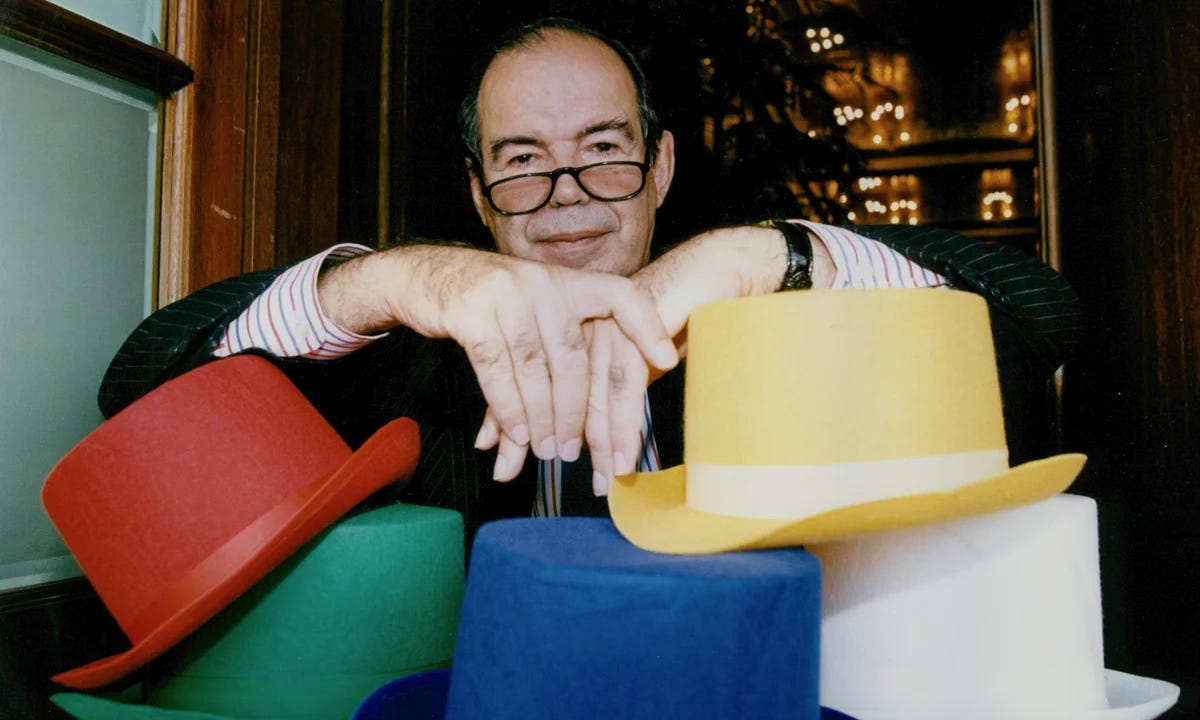
Later came the famous one. Six Thinking Hats.
The idea was simple to the point of seeming silly. In any discussion, people are doing several kinds of thinking at once, all tangled together, and getting cross with each other for doing the wrong kind. The optimist accuses the sceptic of being negative. The sceptic accuses the optimist of being naive. Nobody is listening.
So you give each kind of thinking a colour.
White for facts. Just the data. No opinions.
Red for feelings. Hunch, intuition, gut. No need to justify it.
Black for caution. What could go wrong? The critical hat. The one most managers wear permanently and call it realism.
Yellow for benefits. What could go right? The genuinely useful optimism, with reasons.
Green for creativity. New ideas. Provocations. Wild suggestions.
Blue for managing the process. Thinking about the thinking.
The point is not the colours. The point is that everyone wears the same hat at the same time. Parallel thinking instead of adversarial thinking. You all attack the problem, not each other. A meeting that would have taken an hour of polite warfare takes twenty minutes of actual progress.
It looks like a children’s game. That is rather the point. De Bono thought the dignity of grown-up meetings was costing the world a fortune in unmade decisions.
What he was really saying
Strip away the acronyms, and de Bono’s argument is uncomfortable.
He thought our culture had confused intelligence with thinking. Intelligence is the engine. Thinking is the driver. A powerful car driven by a poor driver is more dangerous than a modest car driven by a good one. We spent a century selecting for engine size and ignoring the driving lessons.
He thought criticism was the easy half of thinking, dressed up as the hard half. Anyone can find what is wrong with an idea. The harder work is making a better one and being willing to look foolish in the process.
And he thought perception was a skill, not a personality trait. You can learn to look again. You can learn to look elsewhere. You can learn to notice what you were about to ignore.
Whether his tools are scientifically watertight is a fair question. Critics have called lateral thinking pseudoscientific, and they are not entirely wrong about the evidence base. But the deeper observation, that we spend too much time judging ideas and too little time generating them, is hard to argue with after about ten minutes in any organisation.
So what
Pick one tool this week. Just one.
Before your next meeting, do a quick AGO. What are we actually trying to achieve here?
Before your next decision, do a PMI. Especially on the option you already like.
Before your next confident opinion, do an OPV. Who else has a stake in this, and what does the world look like from where they are standing?
You will feel slightly silly. That is the fee. The reward is that, every so often, you will catch your own mind in the act of skipping the first stage, and have a chance to make it stop.
De Bono’s wager was that thinking is a skill. Skills are dull to practise and useful to possess. The clever people will keep being clever. The question is whether you can be something rarer.
A person who notices, on purpose.
Alan /|\
Personal Note
I was fortunate enough to train with Dr De Bono, and these “simple’ tools had a profound effect on the way I thought about challenges, problems and situations. They also improved my creativity. I ended up as a De Bono Consultant and, having taught the systems, saw the power of these simple acronyms and coloured hats when used systematically. By the way, children were often better at using these tools than adults. The adults thought they already knew how to think effectively. The higher the degree or diploma, the more fixed or certain they seemed to be.