
Schrodingers Brain
A Beginner’s Guide to Not Understanding Reality (But Feeling Very Clever About It)

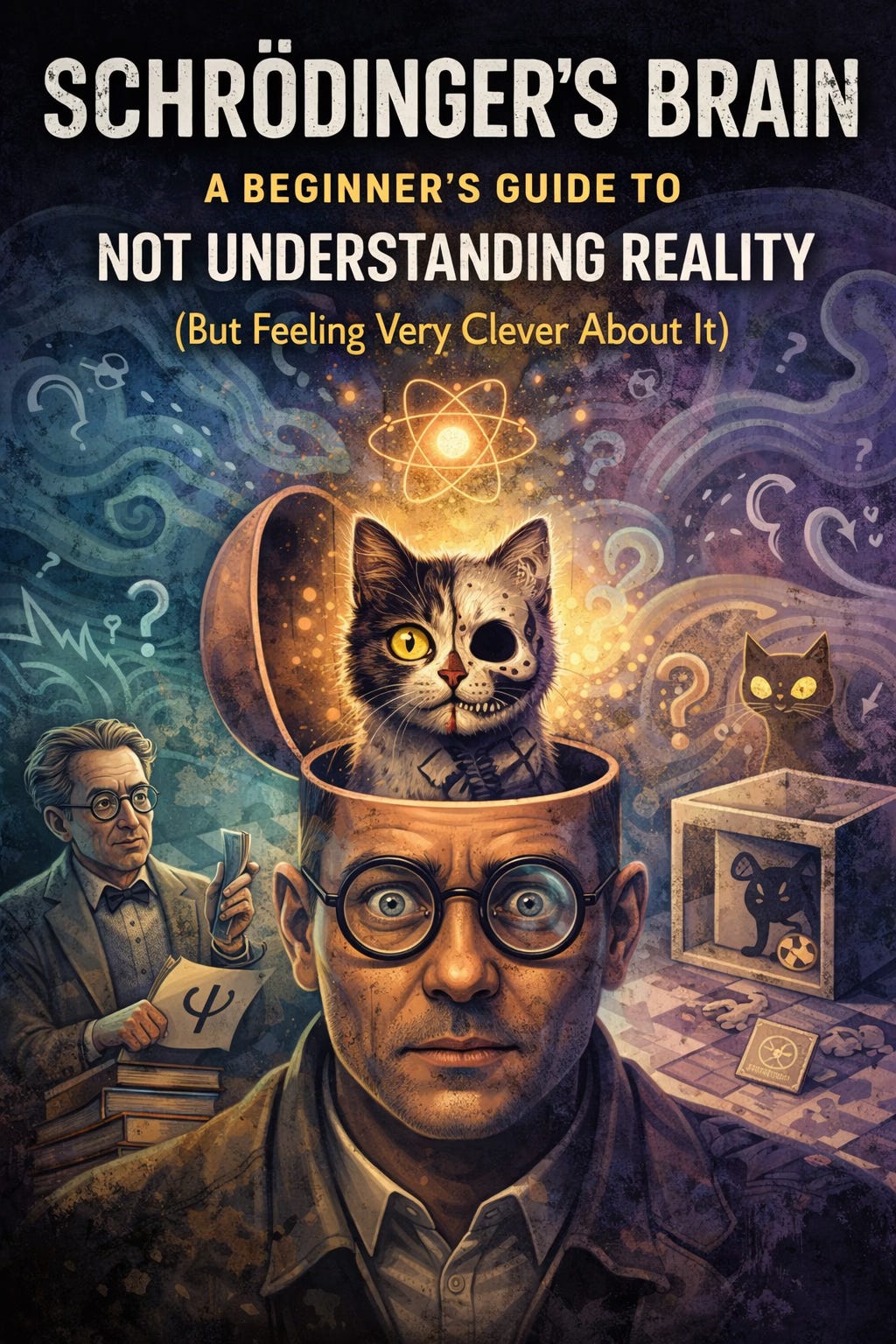
Schrödinger’s Brain: A Beginner’s Guide to Not Understanding Reality (But Feeling Very Clever About It)
Or: How Physicists Accidentally Proved Your Grandmother Was Right About Everything
There is a particular kind of headache that only quantum physics can produce. It sits somewhere behind the eyes, throbs gently whenever you try to think too hard, and is accompanied by the unsettling sensation that the universe is laughing at you. Philosophers have had this headache for roughly two and a half thousand years. Physicists only caught it in 1900, but they’ve been making up for lost time with extraordinary enthusiasm.
Welcome, then, to a guided tour of the two great traditions of human bewilderment: quantum physics and the nature of reality. Bring paracetamol.
What Is Reality, Anyway? (Spoiler: Nobody Knows)
Philosophers got there first, which physicists have never quite forgiven them for. As far back as the ancient Greeks, thinkers were cheerfully dismantling the notion that the world was what it appeared to be. Plato suggested we were all cave-dwellers mistaking shadows for substance. Heraclitus announced that everything was in constant flux — you can’t step into the same river twice — which made bathing philosophically awkward. Democritus proposed that everything was made of tiny indivisible particles called atoms, which was so right it took two thousand years for anyone to believe him, and then another century to discover he was also slightly wrong.
The Enlightenment brought Descartes, who decided to doubt everything he possibly could — rather like a seventeenth-century internet commentator — until he arrived at the one thing he couldn’t doubt: that he was doing the doubting. Cogito ergo sum. I think, therefore I am. This remains the most famous philosophical conclusion ever reached whilst sitting in a heated oven-room wearing a dressing gown, which is either inspiring or a cautionary tale about work-from-home productivity.
Then came Kant, who calmly informed everyone that the world as we experience it — the phenomenal world — is not the world as it actually is. The noumenal world, the thing-in-itself, is fundamentally inaccessible to human perception. We are, in effect, wearing reality-spectacles we can never take off, and we have no way of knowing what reality looks like without them. Kant was German, which explains the vocabulary, and also the thoroughness.
This was the philosophical equivalent of someone announcing mid-dinner party that the food is probably fine, but we can’t actually taste anything — we only taste our impression of the taste. The resulting silence was, historians report, quite considerable.
Enter the Physicists, Stage Left, Looking Confused
For most of the nineteenth century, physics was going rather well. Newton’s laws were ticking along nicely. Maxwell had sorted out electromagnetism. Everything seemed to be moving towards a pleasing conclusion in which scientists explained the universe, collected their prizes, and went home early on Fridays.
Then Max Planck noticed something annoying.
Hot objects were not radiating energy the way the equations said they should. This was called the “ultraviolet catastrophe,” which sounds like a particularly bad sunburn but was actually the prediction that any warm body should emit infinite energy — clearly not happening, since physicists were still alive to be embarrassed by it. Planck fixed the equations by suggesting, somewhat reluctantly, that energy came in discrete chunks rather than a smooth flow. He called these chunks quanta.
Planck himself later admitted he’d introduced the idea as a mathematical trick, not a physical reality, and spent years hoping it would go away. It did not go away. Instead, it became quantum mechanics, the most accurate scientific theory in human history and simultaneously the most baffling thing anyone has ever thought of.
Einstein, not to be outdone, used Planck’s quanta to explain the photoelectric effect, proving that light behaved like particles as well as waves. He won the Nobel Prize for this, which was something of a consolation since his relativity papers were considered too controversial for the prize committee’s blood pressure. The irony of Einstein being considered too radical whilst casually dismantling the concepts of absolute time and space should not be lost on anyone.
The Quantum Bestiary: A Field Guide to Weird Things
Quantum mechanics, at its heart, is a collection of deeply uncomfortable facts about the universe delivered in impeccable mathematical language. Here are the most important ones, presented with the reassurance that your confusion is not only understandable but essentially mandatory.
Wave-particle duality holds that quantum objects — photons, electrons, and so forth — behave like waves when you’re not looking at them and like particles when you are. This is not a limitation of our instruments. It is a property of reality. The universe, it seems, is fundamentally coy.
The uncertainty principle, courtesy of Werner Heisenberg, states that you cannot simultaneously know both the position and momentum of a particle with perfect precision. The more precisely you pin down one, the more uncertain the other becomes. This is not because our measuring equipment is clumsy. It’s because the universe has decided that particles simply do not have perfectly defined position and momentum at the same time. They are, in a technical sense, fuzzy. Philosophers nodded vigorously at this, as it sounded enormously like what they’d been saying for centuries, whilst physicists looked quietly horrified.
Superposition is the principle that quantum systems exist in multiple states simultaneously until measured. The famous illustration is Schrödinger’s cat, wherein a cat in a sealed box with a radioactive trigger is theoretically both alive and dead until observed. Erwin Schrödinger devised this scenario in 1935 to demonstrate how absurd it was to apply quantum principles to everyday objects. The world responded by making it the most recognisable thought experiment in science, putting it on mugs, t-shirts, and motivational posters, which was definitely not what he intended.
Quantum entanglement occurs when two particles interact in such a way that their quantum states become correlated, no matter how far apart they subsequently travel. Measure the state of one particle and you instantly know the state of the other, even if it’s on the other side of the galaxy. Einstein called this “spooky action at a distance” and spent the remainder of his life insisting there must be hidden variables that explained it sensibly. Experiments have since confirmed that no, there aren’t, and it really is that spooky. Einstein was wrong, which he would have found insufferable.
The Interpretation Problem, or: Seven Ways to Be Confused
Having established the equations of quantum mechanics and confirmed them to extraordinary precision, physicists then got into a furious row about what any of it actually means. This row has been going on since approximately 1927 and shows no signs of resolution, which rather vindicates the philosophers who’ve been managing similar rows since at least 500 BCE.
The Copenhagen interpretation, associated with Niels Bohr and his colleagues, essentially says that quantum systems don’t have definite properties until measured, and that asking what’s happening in between measurements is meaningless. This is sometimes summarised as “shut up and calculate,” which is practical advice but not entirely satisfying to anyone with metaphysical ambitions.
The Many Worlds interpretation, proposed by Hugh Everett III, suggests that every quantum event that could go either way actually goes both ways — but in different branches of a constantly splitting universe. Every time Schrödinger’s cat is observed, reality splits into a universe where it’s alive and a universe where it’s dead. There are versions of you who made every decision you’ve ever not made, married everyone you didn’t marry, and ordered the fish when you chose the pasta. This interpretation is mathematically elegant and existentially terrifying.
The Pilot Wave theory of de Broglie and Bohm restores determinism by suggesting particles do have definite positions at all times, guided by a quantum wave that contains information about the entire universe. This sounds reassuringly sensible until you realise the wave is non-local, instantaneous, and invisible, at which point it sounds like something from a particularly well-researched esoteric text.
There are several other interpretations, all plausible, all mutually exclusive, and all supported by exactly the same experimental evidence. This would be a scandal in any other field. In quantum physics, it’s called Tuesday.
Where Physics and Philosophy Finally Shake Hands (Awkwardly)
The convergence is rather lovely once you stop wincing. The Copenhagen interpretation strongly echoes the philosophical idealism of Bishop Berkeley, who argued in the eighteenth century that objects only exist insofar as they are perceived — esse est percipi, to be is to be perceived. Berkeley was roundly mocked. Quantum mechanics has not entirely vindicated him, but it’s certainly made his mockers look less confident.
The wave-particle duality resonates with ancient philosophical traditions that saw reality as fundamentally relational — things defined not by what they are in isolation but by how they interact. Process philosophy, associated with Alfred North Whitehead, proposed that reality was fundamentally about events and processes rather than static objects. Quantum field theory, wherein what we call “particles” are really excitations in underlying fields, would have struck Whitehead as oddly familiar.
The measurement problem — the question of what constitutes an observation, and whether consciousness plays any role — has dragged physics into the philosophical territory of mind and subjectivity whether it wanted to go there or not. Some serious physicists, including Eugene Wigner, have argued that consciousness is genuinely implicated in wave function collapse. Others have responded that this is precisely the sort of thing that happens when you skip lunch and think too hard.
And the question of non-locality — the fact that quantum entanglement connects particles across space in ways that defy classical notions of causation — rattles the very foundations of what we mean by separate objects existing in separate locations. The universe, at the quantum level, appears to be rather more interconnected than common sense suggests. Which is, if nothing else, philosophically interesting territory for anyone who has spent time thinking about the nature of consciousness, spiritual experience, or the peculiar intuition that everything is somehow related to everything else.
Conclusions, Such As They Are
Reality, it turns out, is simultaneously more precise and more uncertain than we imagined. The universe operates according to equations of extraordinary elegance that describe probabilities rather than certainties, waves that become particles only when observed, and correlations that stretch across space without any signal travelling between them.
The philosophers were right that ordinary perception doesn’t give us unmediated access to reality. The physicists confirmed this in painstaking mathematical detail and are still arguing about what it means. The mystics, meanwhile, have been pointing at interconnectedness and the observer’s role in reality for rather a long time, and are perhaps entitled to a small measure of vindication, even if their terminology leaves something to be desired.
What we can say with confidence is this: the universe is far stranger than intuition suggests, far more beautiful than it has any right to be, and fundamentally resistant to the comfortable conviction that we’ve got it all sorted out.
Schrödinger’s cat remains in the box. The headache remains behind the eyes.
And somewhere, a philosopher and a physicist are sitting in a pub arguing about what either of them actually means by “pub.”
Reality is not what it seems. But then, it never was.
Alan /|\