
Synchronicity
Jungian accident or meaningful coincidence?
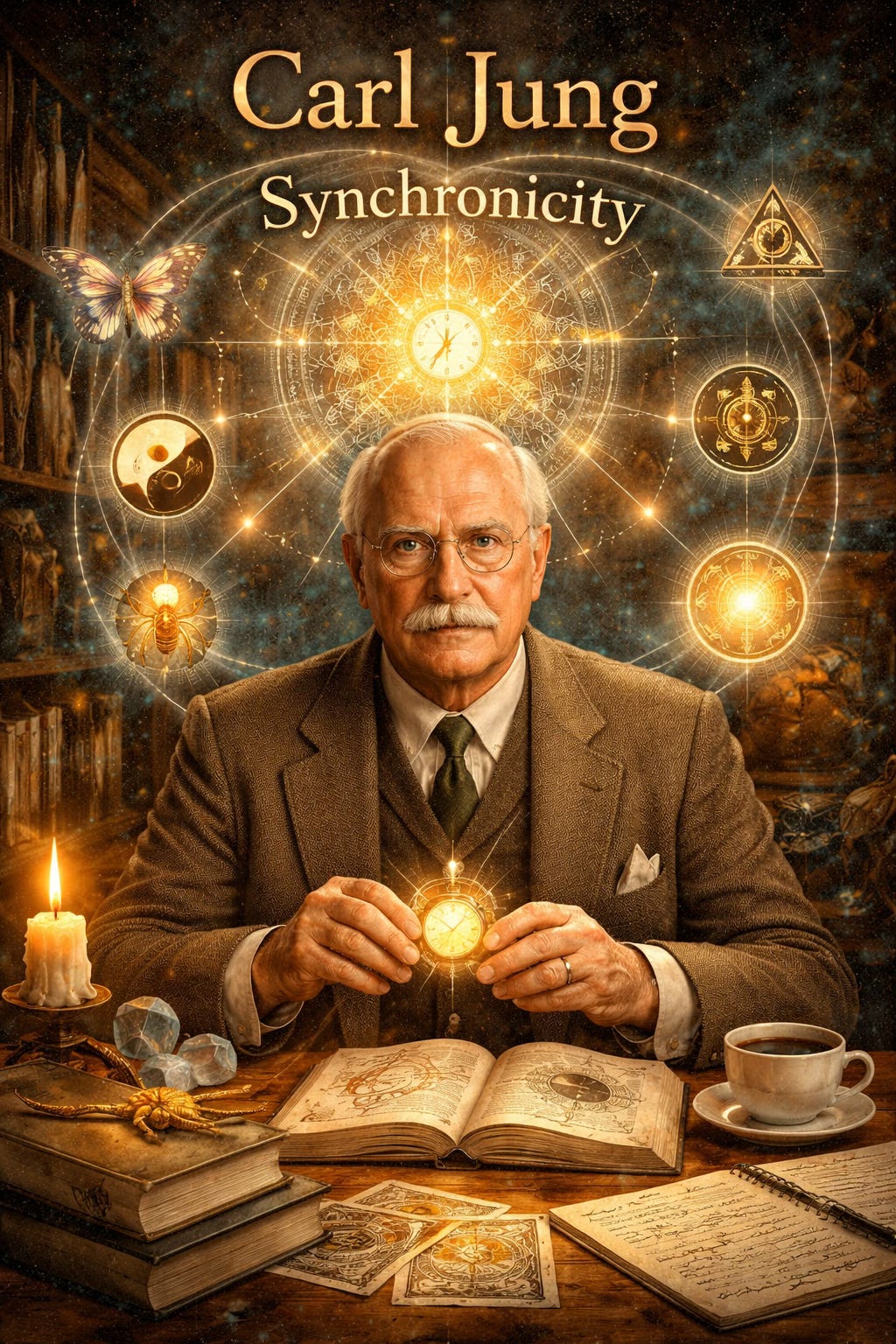
Synchronicity
Jungian accident or meaningful coincidence?
You are thinking about someone you have not spoken to in years. A university friend, a former colleague, the cousin who moved abroad and the phone rings. It is them. Or you encounter the same obscure word three times in a single day, in three unrelated contexts. Or you dream about a death, and the next morning learn that someone has died. You tell the story later. You search for an explanation and find yourself, to your own mild surprise, reluctant to call it a mere coincidence.
Carl Gustav Jung had a word for this. He had a word for most things, which is either a virtue or a warning sign, depending on your relationship with Swiss psychiatrists. His word was synchronicity: the meaningful coincidence of events that have no causal relationship but are connected by their significance to the observer. He spent 30 years developing the concept, enlisted Albert Einstein and Wolfgang Pauli as intellectual sparring partners, and published his definitive account in 1952, a work that delighted mystics, baffled physicists, and irritated sceptics in roughly equal measure. He was, it must be said, extremely good at this.
The Rational Mystic’s position on synchronicity is, characteristically, neither straightforward acceptance nor comfortable dismissal. Jung’s most controversial idea is also, I think, one of his most interesting. Not because it is correct in the way he believed it to be, but because it is pointing at something real about human experience that purely mechanistic accounts of the mind consistently fail to capture. The question is what, precisely, it is pointing at.
“Jung was not a fool and not a fraud. He was a man so determined to take the full range of human experience seriously that he occasionally took rather too much of it seriously. This is an occupational hazard of the psychologically curious. The rest of us can learn from both the reaching and the overreach.”
Part One: What Jung actually meant — and why he thought it mattered
Jung first articulated the concept of synchronicity in the 1920s, though he sat on it for decades before publishing, partly because he knew perfectly well how it would be received. The formal definition, from his 1952 essay: synchronicity is “an acausal connecting principle” — a meaningful coincidence between a psychic state and an external event that cannot be explained by conventional causality.
This definition is more carefully constructed than it might appear. Jung was not claiming that mind causes matter, or that the universe rewrites its own physical laws in response to the contents of individual psyches. He was making a philosophical claim about meaning as a real feature of experience, one that cannot be fully accounted for by a purely causal model of the world. The coincidence, for Jung, was not explained by the meaning; it was constituted by it. Meaning, in his framework, was not merely something minds projected onto events. It was something that events and minds participated in together.
His most famous example — one he used repeatedly because it was genuinely striking — involved a patient recounting a dream about a golden scarab when, at that precise moment, a scarabaeid beetle (the closest European equivalent) flew into the consulting room window. This, for Jung, was not proof that the universe was responding to his patient’s unconscious. It was an instance of a pattern he believed he had observed throughout his clinical practice: that psychologically charged moments — moments of breakthrough, transition, or deep emotional significance — seem to draw meaningful coincidences toward them.
The History Bit: Jung, Einstein, and the Pauli Effect
Jung’s intellectual engagement with synchronicity was not confined to clinical anecdote. In 1909, he had a formative conversation with Einstein — then a frequent dinner guest — about the possibility of a relativity of time and space that might accommodate acausal connections. Einstein later encouraged Jung to publish his ideas.
More remarkable was Jung’s twenty-five-year collaboration with the Nobel Prize-winning physicist Wolfgang Pauli. Pauli had a legendary reputation among physicists for causing laboratory equipment to malfunction simply by entering a room — the ‘Pauli Effect,’ taken half-seriously by colleagues who had seen too many coincidences to dismiss it entirely. Pauli brought mathematical rigour and genuine scepticism to the collaboration; Jung brought clinical depth. Their joint publication, Naturerklärung und Psyche (1952), remains one of the more unusual documents in the history of either psychology or physics.
Pauli’s contribution was not an endorsement of synchronicity as Jung conceived it. It was an exploration of whether the emerging science of quantum physics — with its own deeply counterintuitive features of non-locality and observer-dependence — might provide a framework for thinking about acausal connections. The answer, ultimately, was: not in the way Jung hoped. But the conversation was genuinely interesting.
Part Two: The sceptical case — what is actually going on
The sceptical account of synchronicity is well-developed, well-evidenced, and, I think it is only honest to say, largely correct as far as it goes. Let us walk through the main mechanisms.
Apophenia: the pattern-making machine
The human brain is, at its core, a prediction machine. Its primary function is not to perceive reality accurately but to construct the most useful model of reality as quickly as possible, using the minimum available data. An essential component of this system is apophenia: the tendency to perceive meaningful connections between unrelated things. This is not a malfunction. It is the system working as designed.
In evolutionary terms, a brain that spots non-existent patterns — hearing a predator in rustling leaves that is actually just the wind — pays only a small cost. A brain that fails to spot real patterns — not hearing the predator that is actually there — pays a much larger one. Apophenia is the result: a cognitive system tuned toward false positives, because the cost of a false negative is catastrophic. We see faces in clouds, intentions in random events, and narratives in sequences that have no narrative structure. We cannot help it. We were built this way.
The Psychology Bit: Apophenia and Patternicity
Michael Shermer (2011) coined the term ‘patternicity’ for the tendency to find meaningful patterns in meaningless noise, identifying it as a fundamental feature of human cognition rather than an aberration. The neural basis is well-established: the brain’s default mode network — active when we are not engaged in specific tasks — is heavily involved in narrative construction, self-referential thought, and the attribution of meaning to events.
Klaus Conrad (1958) introduced ‘apophenia’ in a clinical context to describe the early stages of psychotic episodes, in which patients begin to perceive an overwhelming sense of significance in random events. The crucial distinction is one of degree and flexibility: healthy apophenia produces the feeling that a coincidence is meaningful but remains open to revision; pathological apophenia produces unshakeable certainty that resists disconfirmation.
Most synchronicity experiences sit firmly in the healthy range. This does not make them evidential. It makes them interesting.
The law of large numbers — and why we are terrible at statistics
Here is a thought experiment. If you have a social network of two hundred people — a modest figure for most adults — and each of them thinks about you on average once a month, that generates roughly 2,400 person-days per year on which someone is thinking of you without your knowledge. The probability that one of those instances coincides with a moment at which they happen to contact you is not negligible. Given the full population of such events across your entire social network and your entire life, the probability that this never happens even once is extremely small.
This is the law of large numbers applied to human social life, and it explains a great deal of what presents as synchronicity. We live in an extraordinarily large event-space.
Coincidences — even striking ones — are not merely possible but statistically inevitable, given the sheer volume of events, encounters, and thoughts that constitute a human life. The problem is not that coincidences happen. The problem is that we selectively remember the ones that astonish us and forget the vast sea of non-events that surround them.
The statistician’s version: we are not surprised that the lottery is won; we are surprised when we know the winner. The coincidence feels personal because it is personal — it happened to us, or someone we know. But personalness is not evidence of causation. It is a feature of how we experience probability.
“If you sat down and catalogued every thought you had about every person, you know, and compared it to every time those people contacted you, the hit rate would be unimpressive. We remember only the hits. This is not dishonesty. It is how memory works.”
Confirmation bias and the retrospective narrative
A dream about a death that precedes an actual death is remembered as prophetic. The dozens of dreams about death that preceded no such event are forgotten or not coded as significant. A chance encounter with a name or word that then recurs feels like a pattern. The thousand times that name or word was present in the environment without registering consciously are simply not part of the story.
This is confirmation bias operating on the raw material of experience: we notice and retain what confirms the hypothesis (this was meaningful) and discard what disconfirms it (this was random). The story of the synchronicity is constructed after the event, using selectively retained material, and then narrated as though the pattern was always there to be noticed. It was not. The pattern was assembled in the telling.
Part Three: What the sceptical account misses
So far, so debunking. Apophenia, large numbers, and confirmation bias: these three mechanisms account for the overwhelming majority of synchronicity experiences at the mechanistic level. A sceptic can close the file here with a clear conscience and move on.
I am not closing the file here. Not because I think the sceptical account is wrong — it is largely right — but because it is answering a different question than the one Jung was actually asking.
The sceptical account addresses whether synchronistic events have a cause beyond cognitive bias. Jung’s question was about what role the experience of meaningful coincidence plays in the life of the psyche. These are genuinely different questions, and conflating them produces a satisfying debunking that nonetheless walks past the interesting problem.
The phenomenology is real even when the mechanism is not supernatural
Something happens to people when they experience synchronicity. Not physically — no new causal force is detected, no quantum field is disturbed, no supernatural mechanism is at work. But psychologically, the experience of meaningful coincidence can be genuinely transformative. It can interrupt a fixed pattern of thinking, open a possibility that was previously foreclosed, or provide the felt sense of permission that allows a decision to be made.
Jung’s clinical insight — and it was genuinely clinical, grounded in decades of working with patients — was that synchronistic events tend to cluster around moments of psychological transition: individuation, crisis, bereavement, falling in love, or the breaking of a long-established pattern. It is at precisely these moments that the psyche is most activated, most attentive, and most primed to find significance in the environment.
The sceptical explanation for this clustering is straightforward: at moments of emotional intensity, we are more attentive, more primed to notice significance, and more likely to code events as meaningful. The synchronicity is not more frequent; it is more noticed. This explanation is probably correct. It does not, however, make the experience less real or less significant as a psychological event.
The Psychology Bit: Meaning-making and psychological transition
Research on post-traumatic growth (Tedeschi & Calhoun, 1996, 2004) consistently finds that the experience of finding meaning in adverse events, of perceiving a narrative or purpose in what has happened, is one of the strongest predictors of positive psychological outcomes following trauma. This does not require the meaning to be objectively ‘there’ in the events themselves; the act of meaning-making has effects that are independent of the accuracy of the meaning made.
Viktor Frankl’s logotherapy, developed from his experiences in Nazi concentration camps, places the drive toward meaning at the centre of human psychology. For Frankl, the capacity to find meaning in suffering was not a cognitive error but a fundamental human capacity, and one that had survival value in the most literal sense.
Synchronicity, viewed through this lens, is a meaning-making mechanism — one of the ways the psyche constructs narrative coherence from the raw material of experience. Whether that narrative accurately describes an acausal connection in the fabric of reality is a separate question from whether the construction is psychologically valuable.
The unus mundus and the hard problem — a suspicious coincidence
Jung grounded his theory of synchronicity in a concept he borrowed from medieval alchemy: the unus mundus, or ‘one world’. The idea that mind and matter are not two fundamentally separate substances (as Descartes proposed) but two aspects of a single underlying reality. Synchronicity, in his framework, was evidence of this underlying unity: moments at which the boundary between psyche and world becomes temporarily transparent.
This sounds like mysticism. It may be. But here is the suspicious coincidence that a Rational Mystic cannot simply walk past: the hard problem of consciousness — the question of why any physical process gives rise to subjective experience — remains entirely unsolved by contemporary science. We have no satisfactory account of how matter becomes mind.
The philosophical position known as panpsychism. This is the idea that everything has “a mind” or “consciousness”. The view that some form of experience or proto-experience is a fundamental feature of reality, not an emergent product of sufficiently complex brain states. It is no longer the fringe position it once was. Philosophers, including David Chalmers, Thomas Nagel, and Galen Strawson, have advanced serious arguments in its favour.
Jung was not right about synchronicity in the specific way he thought he was right. The universe is not reorganising itself in response to the contents of individual psyches. But the broader intuition underlying his theory, that the relationship between mind and world is more intimate, more complex, and less fully captured by Cartesian dualism than mainstream science has assumed, is not obviously false. It is, in fact, a live question in contemporary philosophy of mind.
“Jung’s error was not in finding the question interesting. His error was in believing he had found the answer. The question, what is the relationship between mind and world?. remains as interesting, and as open, as it was in 1952.”
Part Four: How to live with synchronicity — practically
We have established that synchronicity experiences are real as psychological phenomena and largely explicable by well-understood cognitive mechanisms. The question that remains is the practical one: what, if anything, should we do with them?
As a diagnostic, not an oracle
Jung’s clinical use of synchronicity was not predictive — he was not using coincidences to tell people what would happen next. He was using them as diagnostic material: what does it mean that this person, at this moment, finds this particular coincidence significant? What does the felt meaning of the event reveal about the contents and preoccupations of the unconscious? What is the psyche drawing attention to by flagging this as important?
This is, I think, a genuinely useful reframe. When you notice a synchronicity — when a coincidence strikes you as meaningful — the interesting question is not “Is the universe sending me a message?” The interesting question is “What does it mean that I am finding this meaningful? What does my response to this coincidence reveal about what I am currently thinking, fearing, hoping, or working through?”
The coincidence becomes a mirror rather than a message. This preserves what is valuable in the synchronicity experience — the sense of being in a significant moment, the invitation to attention and reflection — without requiring the abandonment of a coherent epistemology. You do not have to believe the universe arranged the coincidence to find it useful.
As permission, not instruction
Many of Jung’s patients reported that synchronistic events gave them the courage to act on decisions they had already reached but felt unable to act on. The coincidence functioned not as new information but as permission — an external confirmation of an internal conviction they were not yet ready to own.
This is psychologically legitimate and, I would argue, not particularly mysterious. When we are in conflict about a decision, we often need something — a conversation, an event, a felt sense of rightness — to tip the balance from ambivalence to action. A coincidence that feels meaningful can serve this function perfectly well. It does not need to be supernatural to be useful. It needs to be experienced as significant, and the human capacity for significance is, as we have established, extensive.
The caveat is obvious but worth stating: permission is not always wise counsel. A synchronicity that feels like permission to make a decision you have been avoiding should prompt reflection, not immediate action. The question is whether the coincidence is revealing a genuine readiness you could not previously acknowledge, or whether it is providing a convenient rationalisation for something you want to do but know you should not.
“Synchronicity as permission is useful when it liberates genuine readiness. It is dangerous when it licenses avoidance dressed as destiny. The Rational Mystic’s job is to know which is which — which is, admittedly, exactly the kind of thing that is easier to say than to do.”
Part Five: The honest position — sitting with the mystery
Let me say what I actually think, which is something slightly different from what either the committed Jungian or the committed sceptic would say.
I think Jung was wrong about the mechanism. The universe is not a sympathetic consciousness that arranges events to mirror the contents of individual psyches. The scarab beetle was coincidence. The dream about the death was coincidence. The friend who called at exactly the moment you were thinking of them was coincidence. Large numbers, apophenia, confirmation bias, and the selective architecture of human memory account for essentially all of the reported phenomena, and the burden of proof for anything beyond that has not been met.
I also think that coincidence is genuinely strange. Not magically strange, but philosophically strange in ways that a purely materialist account of the world tends to wave past rather quickly. The fact that consciousness exists at all — that there is something it is like to be you, reading this sentence, finding it meaningful or not — is not explained by any current scientific framework. The fact that the universe is comprehensible — that the mathematics that describes subatomic particles also describes the structure of galaxies, that the same physical laws obtain in every corner of the observable cosmos — is, if you look at it steadily, extraordinary.
Jung’s instinct that the relationship between mind and world is more intimate than Cartesian dualism suggests may be more prescient than his critics have acknowledged. Not in the specific way he thought. Not through an ‘acausal connecting principle’ that links psychic events to external ones, but in the broader sense that the neat division between observer and observed, between the experiencing mind and the experienced world, may be more philosophically porous than the common sense view assumes.
This is not a satisfying conclusion, if you were hoping for one. The Rational Mystic does not traffic in satisfying conclusions where the evidence does not support them. What it offers instead is the more uncomfortable and more honest position: Jung’s question was better than his answer. The experience of synchronicity is real and psychologically significant. The mechanism he proposed was not. The philosophical territory the concept gestures toward — the relationship between consciousness and reality — remains genuinely, fascinatingly open.
And if, in the meantime, you find yourself astonished by a coincidence — if the phone rings and it is the very person you were thinking of — you are permitted to find that strange. You are permitted to pause, to attend, to ask what this moment is asking you to notice. You do not have to call it a message from the universe. You can call it an opportunity to pay attention to your own life, which is, all things considered, exactly what Jung was trying to get his patients to do all along.
Conclusion: The meaningful accident
Synchronicity is, in the end, a word for the experience of finding meaning where science says there is none. It describes the moment at which the human meaning-making apparatus — running its ancient, elegant, deeply unreliable pattern-recognition software — flags an event as significant, and the psyche responds to that flag with something between wonder and recognition.
Whether there is anything in the universe corresponding to that flag is a question that remains open and is likely to remain open for some time. The hard problem of consciousness is not going to be solved this week. The relationship between observer and observed in quantum mechanics is not going to achieve consensus interpretation before Tuesday. The question of whether meaning is something minds project onto an indifferent universe, or something minds participate in with a universe that is rather more interesting than standard materialism assumes, is not going to be resolved by a blog article, however well-written.
What we can say is this. The experience of synchronicity is part of what it is to be human. It is woven into the texture of consciousness — into the way we construct narrative, seek pattern, and orient ourselves in time. Dismissing it as mere cognitive error misses what is interesting about it. Embracing it as evidence of a universe responsive to human desire mistakes the feeling of meaning for its confirmation.
The better path, and this, I admit, is easier to advocate for than to walk, is to hold the experience with curiosity and the explanation with humility. To find the coincidence genuinely astonishing without concluding that you know what it means. To use it as a prompt to pay closer attention to your own interior life, without outsourcing your decisions to the arrangements of beetles.
Jung spent a lifetime at this edge — between the explicable and the mysterious, between clinical rigour and genuine wonder. He did not always keep his balance. Neither will we. But the edge itself, I think, is exactly where the interesting questions live.
Alan /|\
Further Reading & References
Jung, C.G. (1952). Synchronicity: An Acausal Connecting Principle. Princeton University Press (1973 translation).
Jung, C.G. & Pauli, W. (1952). Naturerklärung und Psyche. Rascher Verlag, Zurich.
Shermer, M. (2011). The Believing Brain. Times Books.
Chalmers, D. (1996). The Conscious Mind: In Search of a Fundamental Theory. Oxford University Press.
Nagel, T. (2012). Mind and Cosmos: Why the Materialist Neo-Darwinian Conception of Nature Is Almost Certainly False. Oxford University Press.
Frankl, V. (1959). Man’s Search for Meaning. Beacon Press.
Tedeschi, R.G. & Calhoun, L.G. (2004). Posttraumatic Growth: Conceptual Foundations and Empirical Evidence. Psychological Inquiry, 15(1), 1–18.
Atmanspacher, H. & Fach, W. (2013). A Structural-Phenomenological Typology of Mind-Matter Correlations. Journal of Analytical Psychology, 58(2), 219–244.
Mansfield, V. (1995). Synchronicity, Science and Soul-Making. Open Court Publishing.
Beitman, B.D. (2016). Connecting with Coincidence. Health Communications Inc.