

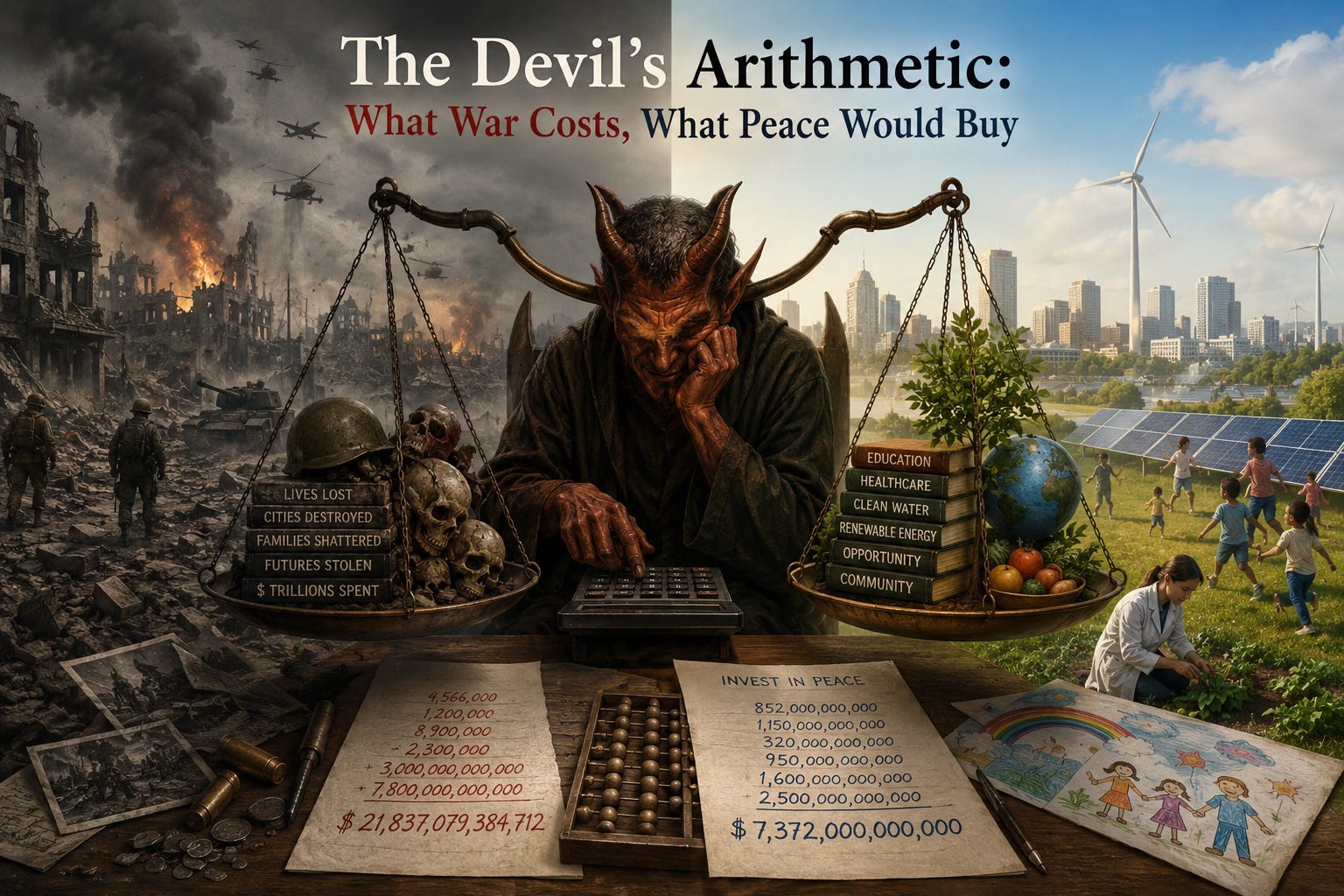
The Devil’s Arithmetic:
What War Costs, What Peace Would Buy
There is a number. It sits quietly in an academic paper, unread by the people who set defence budgets. It says that ending extreme poverty across the globe, all of it, every household living on less than $2.15 a day, would cost $318 billion a year. That is roughly 0.3% of world GDP. Less than humanity spends on alcohol. A rounding error against cosmetics.
Now here is another number. A war that ran for months in 2026, fought over Iran’s nuclear programme, cost somewhere between $42 billion and $113 billion in direct US military spending alone, depending on which tracker you trust and which week you stop counting. Add the knock on costs, the oil shock, the stranded shipping, the fertiliser that never left the Gulf, and the bill climbs past $2 trillion.
Sit with that for a moment. The two figures are not close. One war, in one region, over months, could plausibly outspend a permanent global fix to the worst poverty on earth.
The invoice for a war
The 2026 Iran war began on 28 February and dragged on, with a collapsed truce in June and a second wave of strikes in July. By the most conservative tally, it cost $42 billion in direct spending over 108 days, with a further $87.6 billion requested in supplemental funding from the Pentagon. A separate tracker, counting the July escalation, put the first six days alone at $11.3 billion, the fastest burn rate of any American war on record.
Human cost does not fit neatly into a spreadsheet, but people tried. Fifteen to seventeen American service members killed. Over five hundred wounded. More than 3,600 Iranians dead by cumulative count, over seventeen hundred of them civilians, more than two hundred of them children. Associated strikes in Lebanon added thousands more. Forty two US aircraft lost or damaged. Twenty four drones destroyed. Numbers, stacked like sandbags, holding nothing back.
Then the ripples. Iran closed the Strait of Hormuz on 4 March, disrupting roughly a fifth of the world’s oil trade. Brent crude went past $120 a barrel. Qatar declared force majeure on its gas exports. Gulf states supply nearly half the world’s sulphur and urea, both essential to fertiliser, and that shortage has a lag of six to nine months before it shows up as hunger somewhere far from the fighting. Egypt alone saw $6 billion pulled out of its markets within weeks, and its currency fell by more than eight per cent. The Global Peace Index estimates a resumed war could cost the world economy $2.2 trillion in a single year. The broader global cost of violence, across every conflict, reached $21.8 trillion in 2025, a tenth of everything humanity produced.
That is the price of the sword.
The invoice for mercy
Now the other ledger. Researchers at Berkeley and Stanford spent years building a model using household survey data from twenty three countries, home to half the world’s poorest people. Using AI assisted targeting, direct cash transfers, no bureaucracy, no middlemen, they calculated the true cost of lifting nearly everyone above the extreme poverty line. Their answer: $318 billion a year. A separate, more conservative estimate, aimed only at closing the poverty gap rather than eliminating it outright, came in at $170 billion.
For an American on the median income of $45,000, ending poverty would cost about $135 a year. Less than a decent meal out with excuses.
The researchers were careful to place their number in context. The world spends seven times that on alcohol. It spends more on cosmetics than on saving lives. Foreign aid alone, before this study, ran close to the poverty solving figure without solving anything.
So the arithmetic writes itself, and it is not subtle. One year of a regional war could have paid for the end of extreme poverty on this planet, with change left over. Nobody planned it that way. Nobody sat in a room and chose bombs over bread. But the ledger does not care about intention. It only records what actually happened.
Two ways to spend a trillion
Here is the uncomfortable bit. Poverty does not make headlines the way war does. A missile strike on a refinery is news within the hour. A child going without food for the ninth consecutive month is not news at all, anywhere, ever, unless a photographer happens to be nearby and a war happens to be nearby too.
War is efficient at capturing attention and catastrophically inefficient at producing anything except more war. Poverty relief is the opposite. It is boring, unglamorous, and it works. Cash arrives, the household spends it on food and school fees, and nothing exciting happens on the news that evening. Which is precisely the point.
The devil, if he exists in any useful sense, was never interested in horns and sulphur. He is interested in ledgers. He is the one who ensures that the money always finds the bomb before it finds the child. That is his arithmetic, and we let him keep the books.
The grocery bill
A war ends in the headlines months before it ends in anyone’s grocery bill. The ceasefire gets signed, the cameras leave, and somewhere in East Africa a farmer is still waiting on fertiliser that got stranded in a strait nobody in his village could point to on a map. That is the real timeline of a modern war. Fast to start, slow to finish, and the finishing happens to people who were never asked and never consulted.
Ending poverty has no such lag. The money goes in, and within a season the effect shows up as a full stomach and a child still in school. It is the rare policy that is both cheap and immediate. We simply do not choose it.
Perhaps the question worth sitting with is not whether we can afford to end poverty. The numbers say plainly that we can, and have been able to for years. The question is why a bill for destruction always clears without debate, while a bill for repair sits unpaid on the desk. That is not an economic puzzle. It is a moral one, and it deserves an answer that adds up better than the one we currently give it.
Alan /|\
Sources
NPR, Here’s how much the Iran war cost, and how its effects will linger, 17 June 2026
WarCosts.org, Iran War (2026): Cost, Casualties & Analysis
WarCosts.org / OpenWar, What Did the Iran War Cost? Final Accounting, updated 10 July 2026
Vision of Humanity, The Hidden Price of the Iran War, Global Peace Index 2026, 11 June 2026
Small Wars Journal, The Cost of the Iran War for the United States: A Strategic Blunder in Five Dimensions, 27 April 2026
Wikipedia, Economic impact of the 2026 Iran war
Wikipedia, 2026 Iranian strikes on Saudi Arabia
Sahoo, Niehaus, Selker, Wager, Blumenstock, What Would It Cost to End Extreme Poverty?, NBER Working Paper, December 2025
UC Berkeley Center for Effective Global Action, The End of Poverty, cega.berkeley.edu
Vox, The Low, Low Cost of Ending Extreme Poverty, 17 December 2025
Stanford Daily, $170 billion needed to end poverty, Stanford researchers find, 25 February 2026
Have a look at my author website…