
The Difference Between Buddhism and Taoism
Life is Suffering - Go with the Flow
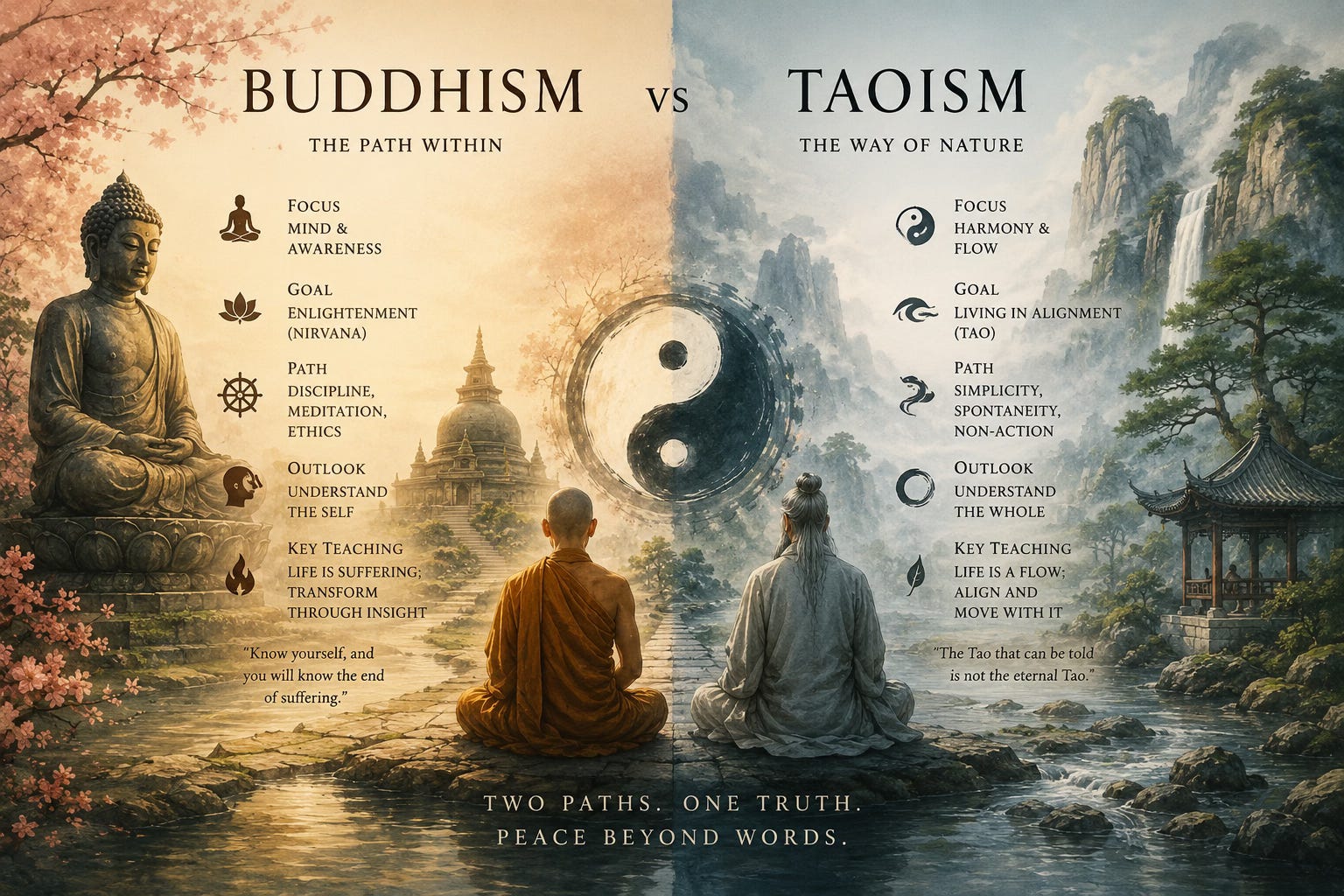
The Difference Between Buddhism and Taoism
A man once asked a Zen master what happens after death. The master said, “I don’t know.” The man was shocked. “But you’re a Zen master.” The master said, “Yes. But not a dead one.”
That joke could belong to Buddhism or Taoism. Both traditions like a good riddle. Both distrust the man who claims certainty. But scratch the surface and you find two very different animals, wearing similar robes.
Two Roads Out of Suffering
Buddhism starts with a diagnosis. Life is suffering. Not tragedy, not occasionally, but structurally. We want things. Things change. We suffer. The Buddha’s plan was clinical. Find the cause. Apply the cure. Eightfold Path. Middle Way. Extinguish craving and you extinguish suffering.
It reads like a doctor’s chart. Symptom, cause, prognosis, treatment.
Taoism has no chart. It has a river.
The Tao Te Ching does not diagnose you. It watches water flow round a rock and asks why you cannot do the same. There is no eightfold anything. There is the Way, and there is your stubborn refusal to stop fighting it.
Buddhism wants you to see through illusion. Taoism wants you to stop interrupting.
The Self, and What to Do With It
Buddhism looks hard at the self and finds nothing there. No fixed soul. No permanent “you”. Just a fast moving bundle of sensations pretending to be solid, like a candle flame that looks the same for hours but is never the same fire twice.
Once you see that, the argument goes, you loosen your grip. Nothing to defend. Nothing to lose. This is not nihilism. It is closer to relief.
Taoism is less interested in dismantling the self and more interested in getting it out of its own way. The self is not an illusion to see through. It is a knot that ties itself tighter the harder it tries to be a good knot.
Wu wei, action without forcing, is the Taoist answer. Stop straining to be virtuous. Stop performing wisdom. The valley does not try to be low. It just is, and everything flows into it anyway.
Buddhism dissolves the self through insight. Taoism just tells the self to sit down and stop showing off.
Where They End Up
Push a Buddhist practice far enough and you arrive at liberation. Nirvana. The candle blown out, in the old, unfashionable but accurate translation. An end to the cycle. A finishing line, however non conventional that finish might look.
Push a Taoist practice far enough and there is no finishing line, because there was never a race. You arrive back at the start, except now you notice the start was rather good all along. The uncarved block. Simplicity, restored rather than achieved.
One tradition is trying to get you off the wheel. The other is trying to get you to enjoy the ride, on the grounds that the wheel was never really the problem. You were.
Why This Still Matters
We live in an age addicted to self improvement, five step plans, morning routines, and the quiet tyranny of “just fix yourself.” Buddhism, taken shallowly, can feed that addiction. Another technique. Another app. Another thing to master.
Taoism is the corrective. It suggests some problems dissolve the moment you stop gripping them. Not every knot needs untying. Some just need your hand to open.
Held together, properly, without turning either into a lifestyle brand, they offer something rare. A way to examine the self honestly, and a way to stop torturing it once you have.
A Small Task For You
Pick one thing today you are gripping too hard. A grievance. A plan. An opinion you are far too proud of.
Do not analyse it to death, Buddhist style. Do not force it to relax, which is its own kind of force. Just loosen your hand, Taoist style, and see what is still standing once you let it fall.
That is the whole difference, in one gesture. Understand the knot, or simply open the hand. Either way works. Neither works if you just talk about it.
So go and try it. The river is not waiting for your permission.
Alan /|\