
The New Thought Movement
A slightly humorous overview...
The New Thought Movement
Or: How a Maine Clockmaker Accidentally Invented the Self-Help Industry and Doomed Us All to Vision Boards
Origins: It All Started With a Man Who Couldn’t Stop Healing People
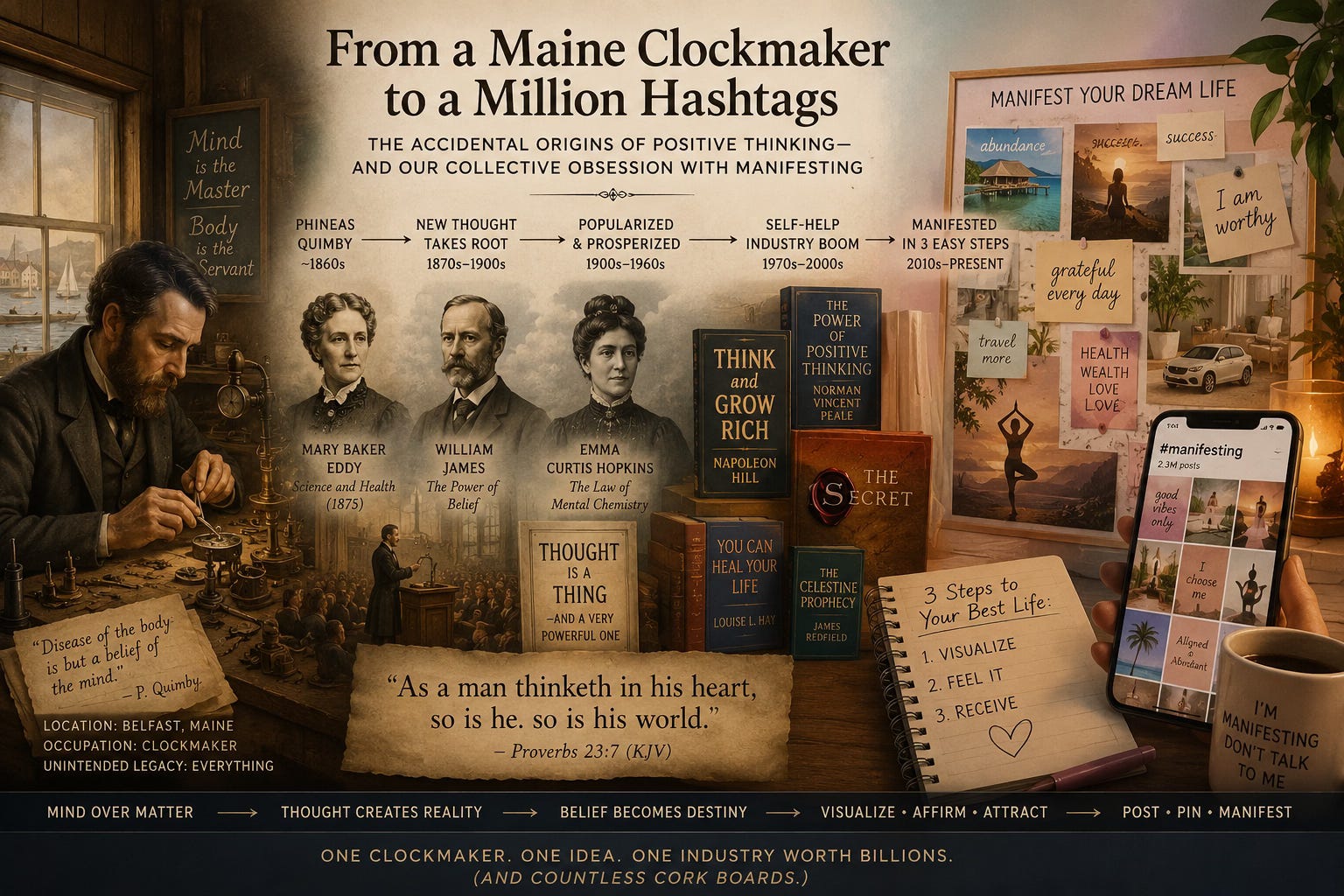
The New Thought Movement began, improbably, in the workshop of a Maine clockmaker named Phineas Parkhurst Quimby (1802–1866), a man who looked exactly as Victorian as his name suggests. Quimby was a sickly fellow obsessed with mesmerism, that fashionable nineteenth-century pseudoscience involving magnets, hand-waving, and the conviction that one’s bowels could be regulated through hypnosis.
Having mesmerised himself into apparent good health, Quimby concluded that all illness was essentially a misunderstanding. The body, he reasoned, was simply doing what the mind told it to, and the mind was, frankly, an idiot being misled by doctors and clergymen.
This was a remarkable theory, particularly in an era when medicine still involved bleeding people and prescribing mercury for headaches. Quimby’s diagnosis, that medicine was largely nonsense and people made themselves sick through wrong belief, was, depending on your perspective, either a profound spiritual insight or the foundational text of every wellness influencer who has ever sold you turmeric. Possibly both.
Quimby never wrote a book. He scribbled notes, treated patients in Portland, and died before anyone thought to make him famous. His ideas, however, did not die with him. They were carried off by his patients like spiritual head lice.
Mary Baker Eddy and the Schism That Wasn’t Quite
The most consequential of Quimby’s patients was Mary Baker Eddy, a frail New Englander whose subsequent founding of Christian Science represents one of history’s great acts of intellectual reattribution. Eddy insisted her ideas came directly from God; Quimby’s followers insisted they came directly from Quimby. The resulting century-long argument has produced more pamphlets than the Reformation.
Christian Science is technically not New Thought. Eddy’s followers will tell you this with the patient firmness of someone explaining for the fifth time that they don’t take aspirin. But the family resemblance is unmistakable: matter is illusion, mind is supreme, and your tumour is a thinking error. New Thought, by contrast, is the more permissive cousin who’ll let you take the aspirin AND visualise wellness AND book a reiki appointment, and who would never dream of forbidding you the chemotherapy.
The Founding Trinity: Hopkins, Trine, and the Wattles of Wealth
The actual New Thought Movement coalesced in the 1880s and 1890s around three figures who deserve more credit and more side-eye than history has given them.
Emma Curtis Hopkins (1849–1925), often called “the teacher of teachers,” is the woman who took Eddy’s ideas, removed the requirement to worship Eddy, and franchised the result. She trained the founders of nearly every major New Thought denomination: Unity, Religious Science, Divine Science. Hopkins was, in effect, the spiritual venture capitalist of late-Victorian metaphysics, and she did this while being a woman in the 1880s, which is genuinely impressive and not at all funny, so we’ll leave her with her dignity intact.
Ralph Waldo Trine (1866–1958) wrote In Tune with the Infinite (1897), a book Henry Ford pressed into the hands of every employee, friend, and probably his mechanic. Trine’s central claim, that there exists a “Universal Mind” with which one can align oneself for health, prosperity, and serenity, has been rebranded approximately four hundred times since, most recently as “manifesting.” The vocabulary changes; the proposition does not.
Wallace D. Wattles (1860–1911) wrote The Science of Getting Rich (1910), a title that tells you everything you need to know about where this is going. Wattles assured readers that the universe wanted them to be wealthy, that thinking in a “Certain Way” would attract money, and that poverty was essentially a failure of imagination. He died the following year, somewhat undercutting the case for his methods. The Science of Getting Rich would later be the explicit source material for Rhonda Byrne’s The Secret, which is to say that the entire 2006 cottage industry of magnetic visualisation was a 96-year-old book in a feather boa.
The Philosophy: Or, What Are These People Actually Saying?
Stripped of its variations, New Thought rests on a small, audacious set of claims:
The universe is mental in nature. Mind is primary; matter is downstream of thought. This is an old idealist position dressed in American clothing, with traces of Hegel, Berkeley, and the Upanishads filtered through a cheerful Yankee optimism that wouldn’t take “the void” for an answer.
Thought has causal power. Not merely on your mood or your circumstances. Believe the right things and the world rearranges. Believe the wrong things and you have arthritis.
The divine is immanent, not transcendent. God isn’t up there judging; God is in here, and also in you, and also in the chair, and possibly in the cat. This is essentially Spinoza for people who don’t want to read Spinoza.
Salvation is psychological. You aren’t saved from sin; you’re saved from wrong thinking. Hell is a mental state with poor furnishings.
The questions this raises are genuinely serious. If consciousness is causally efficacious, does the placebo effect become a window into something profound rather than a methodological nuisance? If divinity is immanent, what does ethics look like when there’s no external lawgiver? If your circumstances reflect your thinking, what do you say to someone born into famine? The movement has good answers, bad answers, and some answers that should be put in a drawer and never spoken of again.
Influence on Modern Philosophy and Culture
The reach of New Thought, once you start looking, is genuinely staggering. William James, in The Varieties of Religious Experience (1902), devoted serious attention to it under the heading “the religion of healthy-mindedness,” treating it as a legitimate American contribution to the philosophy of religion. James was too good a thinker to swallow it whole, but he recognised something authentic in the movement’s insistence that subjective experience matters and that meliorism — the belief that things can be made better — is not the same as naïveté.
From New Thought flow several distinct streams:
The prosperity gospel of figures like Norman Vincent Peale (The Power of Positive Thinking, 1952) and his theological descendants Joel Osteen and Kenneth Copeland — a Christianised, often Pentecostalised, often deeply commercialised version. Peale, incidentally, was the pastor of Donald Trump’s family, which is one of those biographical footnotes that explains rather a lot.
The human potential movement of the 1960s and 70s — Esalen, est, Werner Erhard’s “you create your own reality” — which dropped the explicit theism but kept the metaphysics.
The self-help industrial complex — Tony Robbins, Louise Hay, Deepak Chopra, The Secret, every TED talk that mentions “mindset,” every LinkedIn post about manifesting Q4 targets. This is a multi-billion-pound global industry whose intellectual genealogy traces, with surprising directness, back to a clockmaker in Maine who thought magnets cured dyspepsia.
Even Cognitive Behavioural Therapy, the dominant evidence-based psychotherapy of our time, shares some DNA here, though it would prefer not to be photographed at the family reunion. The CBT insight that distorted cognitions produce suffering is a clinically rigorous, empirically validated cousin of the New Thought claim that wrong thinking causes affliction. Aaron Beck would have words for the comparison; the philosophical resemblance is nonetheless real.
Politics and Religion: The Awkward Conversations
New Thought has always had a politics, even when it claimed not to. Its emphasis on individual mental sovereignty made it congenial to American libertarianism and hostile to structural explanations of suffering. If your thoughts make your reality, then poverty, racism, and illness become, in some uncomfortable sense, your fault. The movement has tried, with varying success, to wriggle out of this implication for over a century. Some of its leaders, particularly women and Black thinkers like the Reverend Johnnie Colemon, used New Thought as a tool for emancipation and dignity in a hostile society — a genuinely radical use. Others used it to sell people stuff.
Religiously, New Thought sits in the strange American space between Protestantism and pantheism — too theistic for atheists, too unitarian for evangelicals, too universalist for traditionalists, and too prosperous for monks. Its enduring appeal is that it offers spirituality without doctrine, transcendence without obedience, and meaning without metaphysical homework. Its enduring danger is that it can shade into a smug indifference to the genuine miseries of existence — what Barbara Ehrenreich, in Bright-Sided (2009), diagnosed as the tyranny of compulsory optimism, the thing that tells cancer patients to think positively as though tumours were impressed by attitude.
What It Asks of Us
The questions New Thought poses are not silly, even where its answers occasionally are. Is consciousness fundamental? What is the relationship between belief and reality? Can a community organised around inner experience produce a coherent ethics? Is optimism a virtue, a vice, or a coping mechanism dressed up as either? Where is the line between agency and self-blame, between empowerment and delusion?
The movement’s deepest claim — that what happens inside our minds is not epiphenomenal, that subjective experience matters, that we are not merely passengers in our own lives — is one philosophy is still working through. The fact that this profound question arrives wrapped in a vision board does not make it less profound. It just makes it harder to discuss with a straight face.
And so we end where we began: with a clockmaker in Maine, who thought he had figured out the universe, and who turned out to have started a movement that would eventually convince millions of people that they could think themselves into a Tesla. He’d probably be horrified. Or he’d take credit. With New Thought, it’s genuinely hard to tell.
PS:
It’s not often I get the opportunity to reference Spinoza in an article and so I thought I’d offer a brief over view of the man and his ideas.
Spinoza’s Key Ideas: A Summary
Baruch Spinoza (1632–1677) was a Dutch-Portuguese Jewish philosopher whose ideas were so heretical that his own community excommunicated him at 23 with one of the most spectacular curses ever issued, and so influential that nearly every major thinker since has had to wrestle with him. He ground lenses for a living, refused a prestigious professorship to preserve his independence, and died at 44, probably from inhaling glass dust.
God, or Nature (Deus sive Natura)
Spinoza’s central and most explosive claim is that there is only one substance in the universe, and that substance is God, but God understood as identical with Nature itself. There is no transcendent deity sitting outside creation; God is the totality of what exists. Everything, stars, stones, thoughts, you, is a “mode” or expression of this single infinite substance.
This is pantheism, or arguably panentheism, and it cost him his community, got his books banned, and earned him the label “atheist” from people who couldn’t tell the difference between “no God” and “God is everything.”
The Two Attributes We Can Know
Substance has infinite attributes, but humans can perceive only two: Thought and Extension (mind and matter). Crucially, these are not two separate things interacting — they are the same reality viewed under different aspects. This dissolves Descartes’ famous mind-body problem by denying its premise. Your mind and body aren’t two substances mysteriously coordinating; they’re one thing seen two ways.
Determinism and Freedom
Everything that happens follows necessarily from the nature of God/Nature. There is no free will in the libertarian sense — choices feel free only because we’re ignorant of their causes. Yet Spinoza isn’t fatalistic. Freedom, for him, means understanding the causes that shape us. The free person is not the one who escapes necessity but the one who comprehends it and acts from their own nature rather than from confused passions.
The Ethics of the Passions
In his masterwork, the Ethics (1677, published posthumously), Spinoza analyses human emotions with the cool precision of a geometer — the book is literally structured like Euclid, with definitions, axioms, and propositions. Emotions are either active (arising from adequate understanding) or passive (arising from confused ideas). Suffering comes from being buffeted by passions we don’t understand. Joy comes from increasing our power of acting and thinking clearly.
The famous line — “Do not weep; do not wax indignant. Understand” — captures the ethical project. Not Stoic suppression, but illumination.
The Intellectual Love of God
The highest human achievement is what Spinoza calls amor intellectualis Dei — the intellectual love of God. This isn’t worship; it’s the serene joy of understanding reality as it actually is, of grasping one’s place in the infinite causal web of Nature. It is, essentially, the experience of comprehending the universe and finding that comprehension itself blissful.
Politics and Religion
In the Theological-Political Treatise (1670), Spinoza argued for freedom of thought and speech, the separation of religion from political power, and a historical-critical reading of the Bible — treating scripture as a human document rather than divine dictation. He was effectively the first modern biblical scholar and a foundational theorist of liberal democracy. He argued that the purpose of the state is to enable people to live freely and rationally, not to enforce orthodoxy.
Key Statements Worth Knowing
Deus sive Natura — “God, or Nature.” The whole system in three words.
“All things excellent are as difficult as they are rare.” (the closing line of the Ethics)
“Peace is not an absence of war; it is a virtue, a state of mind, a disposition for benevolence, confidence, justice.”
“He who loves God cannot endeavour that God should love him in return.” (Love of the universe is not a transaction.)
“Men are deceived if they think themselves free, an opinion which consists only in this, that they are conscious of their actions and ignorant of the causes by which they are determined.”
Why He Still Matters
Spinoza is the philosopher Einstein invoked when asked whether he believed in God (”I believe in Spinoza’s God”). He’s the hidden ancestor of much of modern thought: his immanent divinity prefigures pantheism in Romanticism, his determinism shapes neuroscience’s view of free will, his biblical criticism founded modern religious studies, and his political philosophy underwrites liberal democracy. Deleuze called him “the prince of philosophers.” Hegel said you were either a Spinozist or not a philosopher at all.
He was, in short, a quiet lens-grinder who saw the universe more clearly than almost anyone before or since — and who connects, not at all coincidentally, to that earlier conversation about New Thought, since his immanent God is the philosophical grandparent of nearly every “the divine is within you” claim made in the past 150 years.
Alan /|\