

WHOOPS, WE DID IT AGAIN
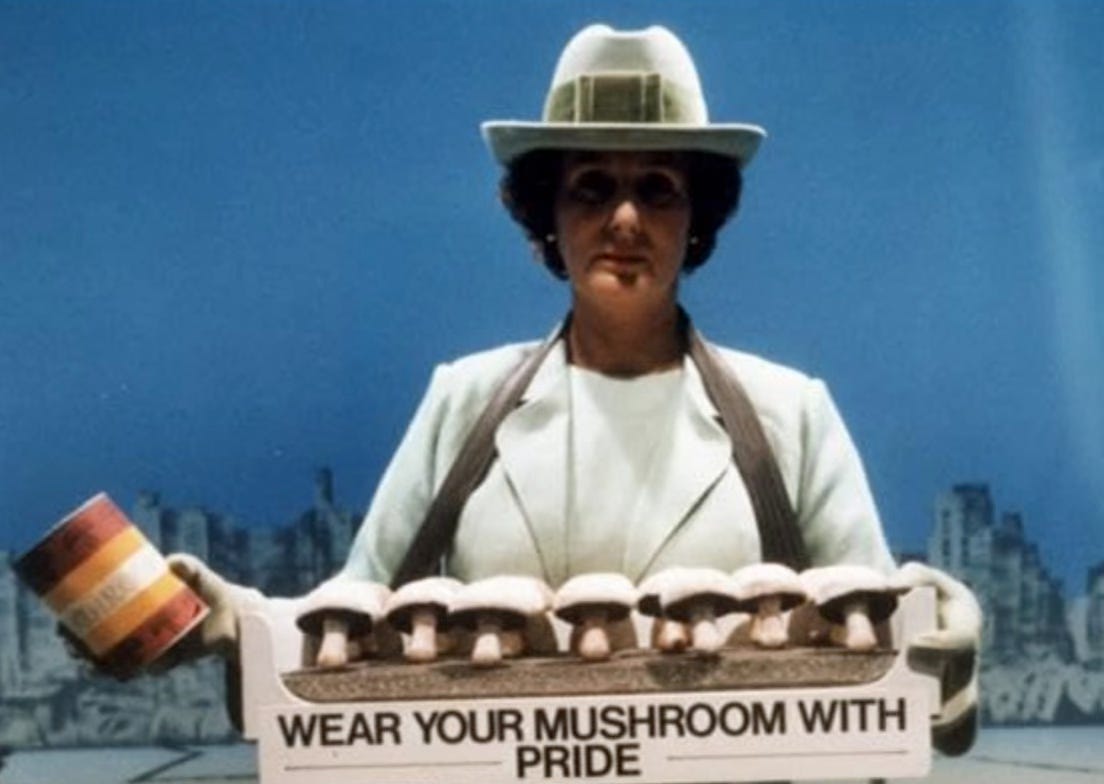
How a forgotten 1980s satire became the most accurate political forecast since Nostradamus — and considerably funnier
“The button is... where exactly?” — A question never far from the minds of satirists, screenwriters, and, one suspects, several sitting heads of state.
The Show Nobody Remembers (But Should)
Cast your mind back, if you will, to 1982. Margaret Thatcher was busy inventing modern misery, Ronald Reagan was cheerfully confusing film scripts with foreign policy, and somewhere in the ITV schedules, tucked between a quiz show and a programme about caravanning, a six-episode satire called Whoops Apocalypse was quietly predicting everything that would go wrong with the world for the next four decades.
Written by Andrew Marshall and David Renwick, the same gentlemen later responsible for One Foot in the Grave, which tells you everything about their cheerful worldview, Whoops Apocalypse depicted a world stumbling toward nuclear annihilation through a combination of political idiocy, military incompetence, religious fanaticism, and leaders whose grip on reality was, at best, approximate.
The American President, ‘Sonny’ Montague (played with magnificent vacancy by Barry Morse), had undergone experimental brain surgery that left him quoting Batman comics during international crises. The Soviet leadership was barely more coherent. A fundamentalist religious group held the balance of geopolitical power. Various third-party actors pursued agendas that served no rational purpose whatsoever.
It was, of course, a comedy. The question now is: was it also a manual?
A Brief and Alarming Plot Summary
For the uninitiated and given that Whoops Apocalypse has never received a proper streaming release, the uninitiated are most of you, the series follows the chain of catastrophic misunderstandings, ego-driven miscalculations, and outright stupidity that propels the superpowers toward mutually assured destruction. There is a missing nuclear warhead. There are incompetent intelligence services. There is a fictional Middle Eastern nation whose oil wealth makes it the pivot of everyone’s foreign policy. There is a British Prime Minister so monumentally useless that he makes previous incumbents look like Pericles.
The 1986 film adaptation (a loose sequel of sorts, starring Peter Cook, Michael Richards, and Alexei Sayle) pushed the absurdism further, adding a secret weapon called the ‘Deathhead Scramble’ and a Ayatollah figure of magnificent implausibility. It flopped at the box office, which is what tends to happen when reality starts competing with satire on roughly equal terms.
The core satirical engine of both the TV series and the film, however, remains as relevant today as a newly sharpened pencil: leaders who are not fully in possession of their faculties, making decisions of apocalyptic consequence, whilst surrounded by advisors too frightened, too ambitious, or too stupid to say ‘I beg your pardon, but have you actually thought this through?’
Fiction Meets Reality: A Comparative Study in Horror
Let us now perform the slightly uncomfortable exercise of holding the script of Whoops Apocalypse up against the current geopolitical landscape and seeing how much light shines through. I warn you: rather a lot.
The Cognitively Impaired Superpower Leader. In the series, President ‘Sonny’ Montague’s brain operation has left him incapable of distinguishing between geopolitical reality and the plot of a 1960s comic book. His aides manage his public appearances with a combination of medication and optimism. The comedy arises from the terrifying gap between the gravity of his office and the vacancy behind his eyes. Marshall and Renwick wrote this as absurdist exaggeration. The past decade of Western politics has treated it as a character brief.
The Unpredictable Ideologue. The show’s fundamentalist religious leader, the ‘Deacon’, pursues goals intelligible only within a theological framework shared by almost nobody else. He is immovable, certain of divine mandate, and entirely unconcerned with the practical consequences of his actions. The writers clearly intended him as a portrait of dangerous irrationality in positions of power. They did not intend him as a job description for multiple actual world leaders, and yet…
The Missing Weapons. A significant portion of the plot hinges on a nuclear warhead that nobody can quite locate. This was satire in 1982. Since then, we have had genuine international incidents involving missing radioactive material, lost nuclear codes, mislaid classified documents, and, in one memorable case, a US Senator who required a map to locate Ukraine. The warhead remains, metaphorically speaking, unaccounted for.
The Pivotal Small Nation. The series features a fictional oil-rich state whose internal politics become the trigger for superpower confrontation. The great powers blunder about, each convinced that controlling this relatively minor territory will tilt the global balance definitively in their favour. Replace the fictional nation with any of a half-dozen real ones — your choice, we are quite spoilt for options — and you have the foreign policy of the past thirty years summarised with impressive economy.
The Intelligence Services That Aren’t. Both the CIA analogue and the KGB equivalent in the series are depicted as organisations of elaborate incompetence, generating vast quantities of intelligence that consistently points in the wrong direction. They brief with total confidence. They are wrong with extraordinary consistency. The tragedy, or the comedy, depending on your proximity to the warheads, is that competent intelligence assessment has never been the bottleneck. The bottleneck has always been whether anyone in power wished to hear what the intelligence actually said.
The Current Situation, Such As It Is
As of the spring of 2026, the world finds itself in the peculiar position of managing several simultaneous conflicts. In Ukraine, across the Middle East, and in the simmering tensions of the Indo-Pacific. Whilst the principal architect of the post-war international order appears to be engaged in a systematic attempt to redesign it along lines that would have struck even the most imaginative satirist as implausible.
The Trump administration’s second term has produced a foreign policy that Whoops Apocalypse would have struggled to script. Proposals to absorb allied nations as American territories, open hostility toward longstanding alliances, back-channel negotiations with adversaries conducted in ways that leave traditional allies uncertain of their status, and a rhetorical style that conflates transactional commerce with international diplomacy. Marshall and Renwick would have been told to tone it down. Too broad, the producers would have said. Nobody will believe it.
Meanwhile, the European response has achieved a level of coordinated hand-wringing previously thought impossible outside of a Whitehall farce. NATO members, having spent decades gently declining to meet their defence spending commitments on the grounds that nothing very serious would ever really happen, are now discovering that something very serious is, in fact, happening and that several of their armed forces are equipped approximately as one might expect after forty years of budget parsimony. Germany has rediscovered an enthusiasm for rearmament that it is approaching with characteristic thoroughness. France has rediscovered an enthusiasm for strategic autonomy that it never actually lost. Britain has rediscovered that it is an island, which is at least something.
Russia continues its war in Ukraine with the peculiar certainty of a power that has conclusively demonstrated it cannot win quickly, apparently in the hope that it can win slowly. The ceasefire negotiations that have dominated headlines in early 2026 combine all the diplomatic elegance of a car boot sale with all the moral clarity of a business merger. Territory is discussed in terms of square kilometres and negotiating leverage. The people who live on it are largely incidental to the arithmetic.
In the Middle East, a region that has been in various states of catastrophic crisis throughout most of living memory, the post-Gaza landscape is being renegotiated in ways that serve almost no one’s long-term interests whilst appearing to serve several parties’ short-term ones. This is not a new situation. It is the same situation, with updated participants.
The Comedy of Escalation
What Whoops Apocalypse understood, and what distinguishes genuine satire from mere mockery, is the mechanics of how rational actors produce irrational outcomes. Nobody in the series wants nuclear war. Everybody is trying to avoid it. The catastrophe emerges not from malice but from miscalculation, misreading, institutional momentum, and the unwillingness of any individual to be the person who says ‘I think we may have made a terrible mistake.’
This is sometimes called the ‘comedy of errors,’ though it is perhaps more accurately described as the ‘tragedy of systems.’ Each player behaves according to their own internal logic. Each decision, locally rational, contributes to a globally disastrous outcome. The audience watching can see the shape of the catastrophe assembling itself, piece by piece, whilst the characters within it cannot. This is the source of the dramatic irony. It is also, if we are being honest with ourselves, a reasonable description of where we are.
The nuclear arsenals of the world’s powers have not diminished. They have, in several cases, been modernised. The arms control frameworks that once — imperfectly, creakingly — provided some structural constraint on the deployment of these weapons have largely been dismantled. The New START treaty has expired. The INF Treaty is long dead. The multilateral institutions that might provide forums for de-escalation are weakened, underfunded, and subject to the veto of precisely those parties most likely to need de-escalation.
And sitting above it all, on various national equivalents of the ‘nuclear football,’ are the authorisation codes. Held by people who are — and here the ghost of Barry Morse’s vacant presidential smile becomes distinctly unsettling — human beings, subject to human errors, human vanities, human rages, and human miscalculations. The button is not metaphorical. It is, in various forms, quite real. And the hands near it are no more reliably steady than they have ever been.
What Satire Can and Cannot Do
There is a view, popular in certain circles, that satire is a form of resistance — that by laughing at power, we somehow diminish it, expose it, make it more legible and therefore more accountable. This is a comforting view. It is also, the historical record suggests, somewhat optimistic. Satire did not prevent the policies it mocked in Weimar Germany. That Was The Week That Was did not fundamentally alter the trajectory of British politics. The Thick of It — perhaps the finest political satire in the history of British television — documented the dysfunction of New Labour and the coalition years with forensic brilliance, and changed precisely nothing.
What satire can do is name things. It can say: look at this. Look at how absurd this is. Look at how the mechanisms that are supposed to protect us are failing, and how the people who are supposed to lead us are not quite adequate to the task. It cannot compel anyone to look. It cannot force the acknowledgement. But it can put the absurdity on record, so that future generations — if there are any, Whoops Apocalypse being what it is — will know that someone noticed.
Marshall and Renwick noticed in 1982 that the system by which nuclear-armed superpowers managed their rivalry was held together largely by good fortune, institutional inertia, and the reluctance of any individual to be the one to break it. They noticed that the leaders of those superpowers were, in various ways, unequal to the responsibilities they held. They noticed that the supporting cast of advisors, generals, intelligence chiefs, and diplomats was largely optimised for career survival rather than geopolitical wisdom.
They made it funny because the alternative was to make it something else entirely, and nobody would have commissioned that.
A Modest Proposal for the Archive
Some cultural artefacts belong in the museum. Some belong in the curriculum. Whoops Apocalypse belongs, I would argue, in the briefing packs distributed to incoming heads of state, as a kind of illustrated warning. A picture book for people who have recently acquired access to weapons capable of ending civilisation and who may benefit from a gentle reminder of how easily things can go very wrong.
The series is, of course, available in the usual grey-market ways that television from this era tends to be available — grainy transfers, inconsistent audio, the unmistakable quality of something recorded off-air in 1982 by a man in Wolverhampton whose video recorder was set to the wrong speed. It is worth the effort. It is funnier than the current situation, and marginally less frightening, which is something of an achievement.
Andrew Marshall and David Renwick did not know they were writing prophecy. They thought they were writing comedy. The distinction, in the fullness of time, has proved less robust than one might have hoped.
The best satire is the kind that ages badly because the thing it was satirising has stopped happening. Whoops, Apocalypse has not aged badly. It has aged, if anything, rather too well.
Alan /|\